 Sanjay OrugantiResearch Scientist · Rensselaer Polytechnic Institute
Research project · multi-robot systems
IKT-BT
Robots that learn by overhearing their teammates
- Published in
- IEEE Transactions on Cybernetics, 2025
- My part
- First author
- Where
- HeRo Lab and DICE Lab, University of Georgia
- Builds on
- KT-BT
Overview
Instead of every robot asking the same questions over and over, a robot can listen in on its teammates and learn passively, the way a person picks up a skill by overhearing someone explain it.
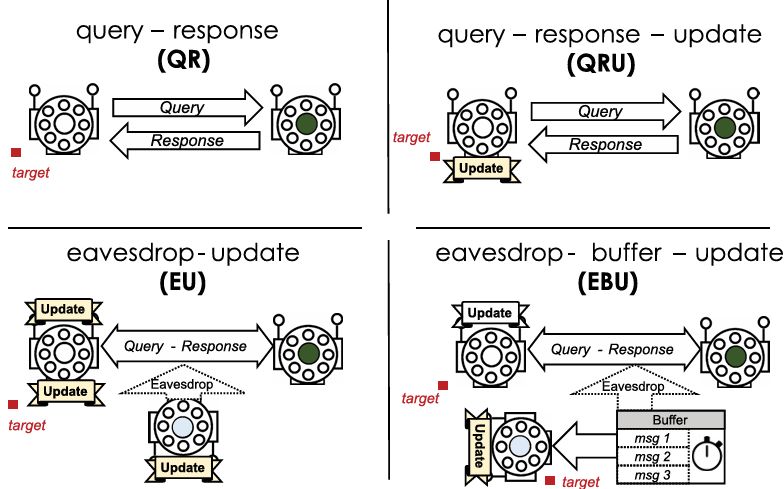
Robot teams usually share what they know by talking to each other directly. IKT-BT (indirect knowledge transfer through behavior trees) adds eavesdropping: a robot that overhears two teammates exchange knowledge keeps it too. Knowledge and control both live in behavior trees, so what is overheard can be used at once, and the team spreads procedural knowledge without crowding its communication channels.
How it works
Modality 1
Eavesdrop–update (EU)
A robot that overhears a query–response exchange between two teammates learns from it immediately, updating its own behavior tree with the knowledge it intercepted.
Modality 2
Eavesdrop–buffer–update (EBU)
Overheard messages are held in a buffer before they are used to update the behavior tree, an episodic-memory strategy suited to resource-limited swarm robots.
Results
-
Better missions
In simulated search-and-rescue missions, teams that eavesdrop finish the job better than teams that only ask and answer.
-
Knowledge spreads further
More robots end up knowing more, because every exchange teaches the listeners as well as the asker.
-
Less talking
The team needs fewer direct messages, and the paper backs the experiments with a theoretical analysis.
Explore further
Paper and code
Related work
- On this site KT-BT The direct version this work builds on: robots ask a teammate for the knowledge they lack. Project page →
- Paper Doctoral dissertation Exploiting Emergence, Heterogeneity, and Knowledge Transfer in Multi-Agent Systems. University of Georgia ↗
- Lab HeRo Lab Heterogeneous Robotics Research Lab, where the multi-robot work was done. herolab.org ↗
- Lab DICE Lab Design Informatics and Computational Engineering Lab, College of Engineering. University of Georgia ↗
Cite
IEEE T-CYB
IEEE Transactions on Cybernetics, 55(6), 2558–2570 (2025).
BibTeX
@article{oruganti2025indirect,
  author = {Oruganti, S. and Parasuraman, R. and Pidaparti, R.},
  title = {IKT-BT: Indirect knowledge transfer behavior tree framework for multirobot systems through communication eavesdropping},
  journal = {IEEE Transactions on Cybernetics},
  volume = {55},
  number = {6},
  pages = {2558--2570},
  year = {2025},
  doi = {10.1109/TCYB.2025.3560564}
}